
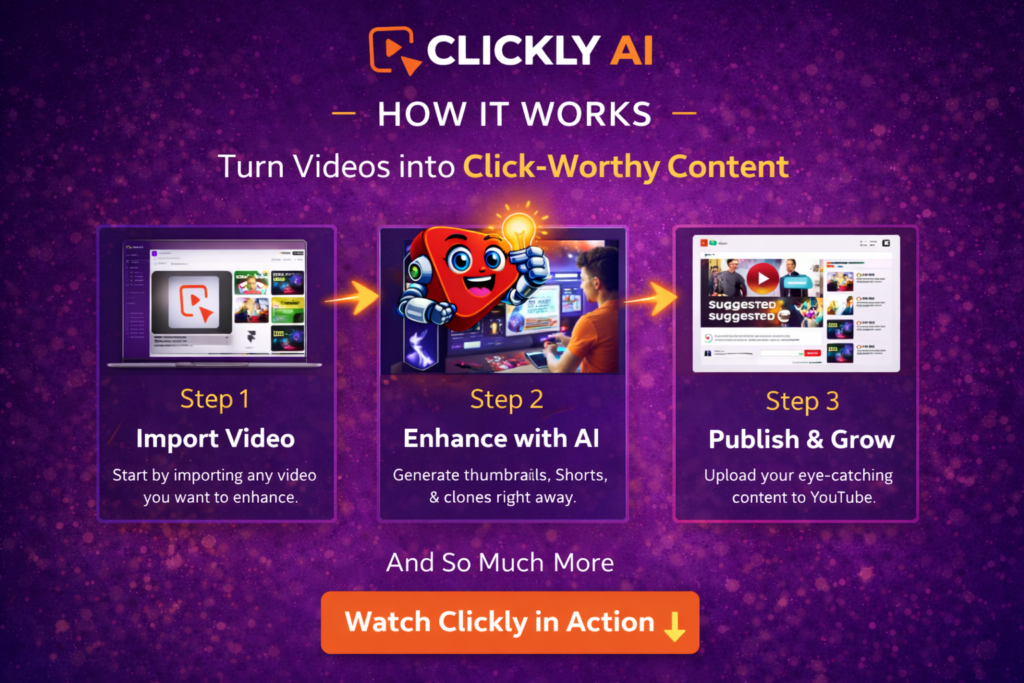
If you’re wondering how Clickly AI actually works behind the scenes, this page explains the entire process from start to finish.
Instead of vague promises, this is a practical walkthrough of what happens inside the platform, how the AI generates thumbnails, and how you can use Clickly to improve your YouTube click-through rate in real life.
For a complete product overview with features, pros, cons, and use cases, you can read the detailed Clickly AI review.
The Core Idea Behind Clickly AI
Clickly AI is built around a very simple but powerful concept:
Don’t design thumbnails from scratch. Start from thumbnails that already worked.
Most creators struggle because they:
- Guess what looks good
- Copy random designs
- Follow personal taste instead of data
Clickly removes guessing by using real-world YouTube performance data.
Every thumbnail structure inside Clickly is inspired by videos that already achieved:
- 100,000+ views
- Often 500K, 1M, or even 2M+ views
So the system starts with what already works and then adapts it to your content.
Step 1: Paste Your YouTube Video Link
The first step inside Clickly is extremely simple.
You paste your YouTube video URL into the dashboard.
Once submitted, Clickly’s AI analyzes:
- Your video title
- Topic and niche
- Keywords
- Emotional intent
- Similar high-performing videos
This process usually takes only a few seconds.
You don’t need to upload files or describe your content manually.
The system reads everything automatically.
Step 2: AI Analyzes Viral Thumbnail Patterns
After scanning your video, Clickly’s AI looks for:
- Viral thumbnail structures
- Emotional design patterns
- Visual layouts that trigger clicks
These patterns come from:
- A massive internal thumbnail database
- Real YouTube performance data
- Proven CTR-based designs
This is where Clickly is different from generic AI tools.
It doesn’t invent random designs.
It reuses what already worked in your niche.
Step 3: Clickly Generates Thumbnail Variations
Once the analysis is complete, Clickly generates:
- 3 to 4 thumbnail variations
- Each based on proven patterns
- Each optimized for emotional triggers
These variations allow you to:
- Compare options
- Split test
- Choose the strongest design
Instead of testing 20 bad thumbnails, you start with 4 good ones.
Step 4: Face Cloning (Optional but Powerful)
Clickly includes a feature called AI Headshot & Expression Cloner.
You upload one photo of yourself, and Clickly generates:
- Multiple facial expressions
- Different emotions
- Different angles and poses
These faces are automatically inserted into thumbnails.
This is especially useful for:
- Review channels
- Coaching channels
- Personal branding
- Authority-based content
Because human faces still dominate CTR on YouTube.
Step 5: Export to Canva for Editing
Once you choose a thumbnail, you can export it to Canva with one click.
Inside Canva, you can:
- Edit text
- Change colors
- Move elements
- Replace images
Even the free Canva account works.
This gives you:
- Full customization
- No design restrictions
- No locked templates
You always stay in control.
Step 6: Upload and Test on YouTube
After editing, you download your thumbnail and upload it to YouTube.
This is where the real benefit happens.
Because your thumbnail is based on:
- Proven viral structures
- Emotional psychology
- Data-backed patterns
You significantly improve your chances of:
- Higher CTR
- More impressions
- More views
Clickly doesn’t change your content.
It changes how many people click it.
Why This Process Works So Well
The Clickly system works because it aligns with how YouTube actually ranks videos.
YouTube rewards:
- Click-through rate
- Watch time
- Engagement
If nobody clicks your video, YouTube stops promoting it.
Clickly improves the first and most important signal: CTR.
Better thumbnails = more clicks = more exposure.
No Design Skills Required
One of the biggest advantages of Clickly is simplicity.
You do not need:
- Photoshop
- Graphic design skills
- Creative talent
You only need:
- A YouTube video
- Basic text editing
Everything else is automated.
Works for Any Niche
Clickly works across almost every YouTube niche:
- Affiliate marketing
- SaaS tools
- AI tools
- Business
- Education
- Coaching
- Finance
- Health
- Entertainment
If your niche exists on YouTube, Clickly can generate thumbnails for it.
Ideal for Faceless Channels
Even if you don’t want to show your face:
- Clickly still works
- Templates still convert
- Emotional visuals still perform
Face cloning is optional.
You can use:
- Text-based thumbnails
- Graphic-based designs
- Visual storytelling
Time and Cost Efficiency
Clickly replaces:
- Designers
- Freelancers
- Fiverr gigs
- Endless testing
Instead of spending:
- Hours designing
- Money outsourcing
- Weeks experimenting
You generate optimized thumbnails in under 60 seconds.
This makes Clickly extremely efficient for:
- YouTube automation
- Multiple channels
- Daily uploads
Is Clickly AI Hard to Use?
No.
Clickly is designed for:
- Beginners
- Non-technical users
- Marketers
- Content creators
The interface is simple:
- Paste link
- Generate thumbnails
- Export to Canva
- Upload
No training required.
Does Clickly Guarantee Results?
No tool can guarantee views.
Clickly does not control:
- Your content quality
- Your niche demand
- Your consistency
What it improves is:
- Visual appeal
- Emotional triggers
- Click behavior
Which directly affects:
- CTR
- Impressions
- Growth potential
Pricing and Access
Clickly is offered as a one-time lifetime deal.
No monthly fees.
No subscriptions.
You can see full pricing here:
👉 Clickly AI Pricing
This makes it much cheaper long-term than:
- Monthly design tools
- Hiring designers
- Ongoing outsourcing
Final Thoughts on How Clickly AI Works
Clickly AI works because it removes the biggest problem in YouTube growth:
Not knowing what thumbnails actually work.
Instead of guessing, you start from:
- Proven patterns
- Real data
- Viral structures
Then you adapt them to your content.
It’s not magic.
It’s data-driven design for YouTube.
And in a platform where attention is everything, that makes all the difference.